Friday, 13 January 2017

Why should we marry??

I was thinking that why should we marry and I was telling my friends that I am going to become sanyasi and I told them that I am not going to marry .They was teasing me that  you are the first guy going to be married in this group.They were telling like this . After I realized that each woman should marry a man . Because parents can't be the full supportive throughout our life.They can bare us upto their ages not after they grew old.Do you know why should we marry??If you get married you know to understand each other and you care for them.You will acknowledge more after getting married.You have some responsibilities after marriage.If you get married,you would become healthy.Because singles become lazy even to eat food and to cook.Singles always used to sleep more.singles do not have supportives after their parents.And they doesn't know about the love, carings and also the responsibilities.They may even face financial crisis.No one to care for him/her when they fell in sick.But married couples have love,carings,responsibilities,support,etc..,More than that marriage is a lifetime commitment.It is our Indian culture to marry after becoming a major(right age to marry).So,realize like me and marry hope u guys marry.

          -SUSHMITHA.G

Government role in married lives:

One of my point is about marriage license.In the United States,every state requires a couple to obtain a married license,and it is also called as marriage certificate,in order to legalize their marriage.Marriage license is a proof of  a couple's new legal obligations to each other as husband and wife.Getting a marriage certificate is good for their benefits.


Marriage certificate is a document,which provides a valuable evidence of marriage,providing social security,self-confidence particularly married women.And it will be useful in getting the visa for the wife/husband.It will be helpful in claiming the Bank deposits or Life insurance benefits when the depositee or the insurer dies .So,our government also plays an important role for our lives.Is our government doing good for us in married lives if so what are they ???

Arranged marriages seems more successful than love marriages:

Arranged marriages seems to be more successful than love marriages because in love marriages we should face many consequences and we have to face many risks in life ,if no one supports us .But in married life we have a strong support of our parents.Many will tell that love marriages are best because they will tell that in love marriages they understand each other .And they knows them each other for a long time.If there is no support in love life more probably they will be facing more problems like facing the society,facing parents,facing financial problems,etc..For arranged marriages they do not have  such problems like this .And even a arranged married couples knows each other after their engagements or after their marriages even they to have love and bond each other.Love marriages give temporary pleasure but permanent pain.But arrange marriages give temporary pain but permanent pleasure.Do you want to know why??I can tell that being united with family only makes pleasure not being alone with their married  ones and his/her daughter/son.Arranged marriages are 100% perfect,because our parents loves us very much and only they will make us the best decisions for us.And no love is greater than our parents love.If you believe in parents love ,I feel that you guys to will be choosing the arrange marriage.The arrange married couples will be guided by their parents experience whereas in love marriage is unknown about the future complexities in life and lacks this experience.According to love marriage there is no long time relationship between them . Marriage is a lifetime commitment.So,I prefer arrange marriages are best in life .This is my opinion....
And what is your opinion on this marriage??
-SUSHMITHA.G

Sunday, 8 January 2017

KANYADAAN

The True Significance Behind The 'Kanyadaan' Ceremony In Indian Weddings
In the Hindu tradition there are many rituals and customs that are involved in a wedding. While the groom is considered to be an incarnation of Lord Vishnu, the bride is considered to be a form of Goddess Lakshmi, the deity of wealth and prosperity. Therefore, giving the daughter away (or kanyadaan) is a very emotional as well as a religiously significant act for the bride's parents in an Indian wedding.
It is a moment in every wedding that is charged with emotions, as the father makes the ultimate sacrifice by giving away his beloved daughter into the care of another man, her husband, for lifetime. Come with us as we take a journey into the emotional and religious significance behind the kanyadaan ceremony of a traditional Indian wedding.

Emotional significance of giving the daughter away:

To understand why kanyadaan is so emotionally charged, it is important to understand how a father feels for his daughter. This is something that is not unique to India, for it is a global emotion that fathers share a special bond with their daughters while the mother and son have a close bonding. Even the most possessive and rigid father is known to melt under the sweet smile of his daughter. Fathers consider their little girls as the most prized possessions, and take great care in their upbringing. They are also the ones who pamper all their wishes, despite the scolding from the mother! So close is their bond that the thought of just handing her over to someone else can be heart-wrenching. However, it is a fact of life that every Indian wedding must have a kanyadaan.

Moment of kanyadaan at an Indian wedding:

Though this particular ritual of handing over the responsibility of the daughter to another is not peculiar to Hindu tradition, it is definitely given more importance due to its religious implications. A typical Indian wedding starts with the usual pomp and festivity, with everyone cheering the bride and the groom through the different rituals. Even the seven vows that the couple takes around the holy fire, is something that brings on some teasing and smiles. However, the atmosphere completely transforms when the father of the bride places her hands into the groom's.
For the father of the bride, this is a symbol that he is now transferring his daughter's responsibility to the groom. Considered as the noblest donation possible by a couple, giving away of the “prosperity” of their life, is an emotional moment for everyone who is present.

Religious significance and ritual of kanyaadan:

As the groom is considered to be Lord Vishnu at the time of the wedding, kanyadaan is the biggest offering that any parent can ever make to the God. It is believed that kanyadaan purifies the parents’ of the bride of all their sins (even those that they might have committed in their previous births).
It is also a ritual where it is stressed for the groom that his bride is the most precious “gift” that he will ever receive in his life, and he has to honour her and cherish her likewise. The groom promises to take care of their daughter, forever.
Taking place just before the mangalpheras, during this ceremony, the father of the bride places her right hand in that of the groom’s, this is known as hastamilap. Along with this, betel leaves, betel nut, flowers, dry fruits, conch, gold and money are also placed in their hands. After this, holy water or milk is poured over their palms, as the holy verses are being recited by the priest.
The groom then places his hand on the right shoulder of the bride, as his way of taking on her responsibilities. All this symbolises that their fates and lives are now interlinked. In certain communities, after this, the hands of the bride and the groom are tied together with a white cloth to secure their bond from the evil eye. The groom holds the bride’s hands even as they take the pheras, and recite the holy vows of togetherness.
The Hindu traditions place a lot of stress on fasting, before participating in any religious event. In most communities, parents of the bride observe a fast before making the ultimate donation or "daan” of their daughter.
Though kanyaadan is an emotional moment for fathers and daughters, it is also an intrinsic part of the entire wedding. It is one ritual that cuts the link of the bride with her family, and leaves her free to accept the new family and life that she is now a part of. 

- Tulasi Tejaswini

Saturday, 7 January 2017

Hi guys, i came to know about an interesting wedding. It happened before a year or two in Tamil Nadu but I am not sure of  the District. The Wedding took place in a village with NATURE. Quite interesting right?
              The wedding took place in a paddy field.The rituals were well performed in Hindu tradition. And after the rituals performed, they PLANTED A SAPLING and mentioned that this was the duty first performed by them after getting married.Thy even insisted their relatives and friends to plant trees. This showed their social responsibility.
              So, this wedding is quite mentioned and this a creative way to do their social duty and
 make others know about it.
 Guys, u can comment some interesting wedding ceremonies you know.
(R.R.Jayaniveatha Lakshmi)

Saturday, 24 December 2016

Why Indian opponents of same-sex marriage are so horrified at the US verdict

one of the most influential courts in the world ruled in a 5-4 decision that same-sex marriage is legal.  The US Supreme Court went on to define the idea of marriage within the folds of love and commitment. “Rising from the most basic human needs, marriage is essential to our most profound hopes and aspirations,” wrote Justice Anthony Kennedy for the majority.


This decision ended several decades of debates in US law and policy on marriage, religion, and the freedom of states over central government institutions. But while the US Supreme Court might have had the last word on same sex marriage in the US, here in India the debate is still rife.

Within weeks of the Delhi High Court decision in 2009 legalising gay sex, the Supreme Court of India received more than a dozen appeals filed by fringe religious organisation which, incoherently, but not without conviction argued that their opposition was linked to the fear that this would lead to gays and lesbians getting married.

But in the real world...

However, Indian gays and lesbians ‒ taking a leaf from the inter-faith and inter-caste runaway weddings ‒ have been marrying already, at least for a while. In 1987, news emerged that two policewomen, Leela and Urmila, in Bhopal, had been suspended because they had married each other. It was, of course, not a legal wedding: at best, a Bollywoodesque run-away temple satpadi wedding with a favourable pundit and an exchange of varmalas.

The indomitable spirit of this couple in love did not necessarily catalyse the modern day gay rights movement in India. But it has ‒ at least for some of us ‒ served as a continuous reminder of both the aspirations and possibilities that lie at the heart of the struggle for gay rights.

source link: http://scroll.in/article/737216/why-indian-opponents-of-same-sex-marriage-are-so-horrified-at-the-us-verdict
(g.yuktha lakshmi)

Wednesday, 7 December 2016

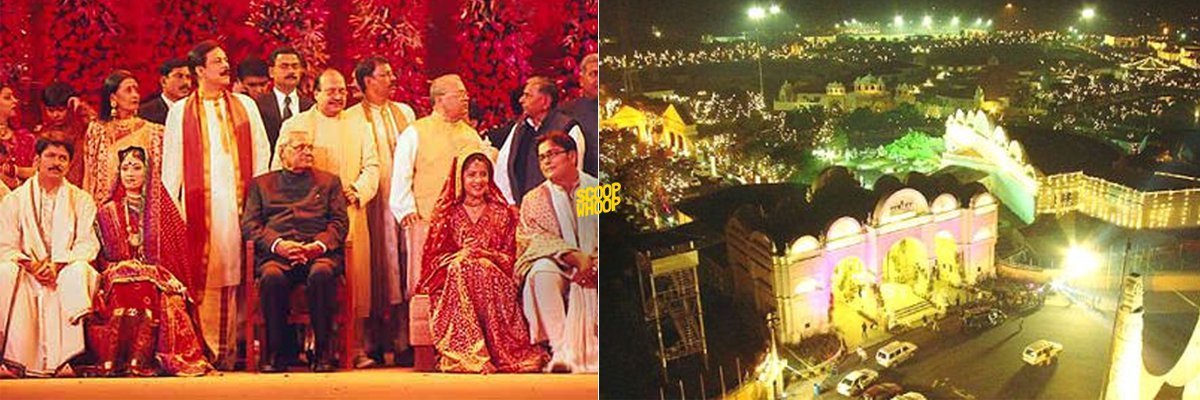
Expensive wedding

!!This will be the expensive wedding so far!!

Who : Sahara Chief Subrata Roy's sons' double wedding

Where: Lucknow

Cost :₹552 crore

The weddings of Subrata Roy’s sons, Sushanto with Richa and Seemanto with Chandini took place at the Sahara Auditorium in Lucknow in 2004. The wedding dresses were from famous designers like Rohit Bal and Sabyasachi Mukherjee. The venue was luxuriously decorated with mashals , torch lights, wax lights and prism glasses. There were 110 types of dishes from across the world. Amitabh Bachchan, Aishwarya Rai Bachchan, Kapil Dev, Anil Ambani, along with several other famous celebrities were present at the event.

My opinion is that a marriage is to show their status in the society. Nowadays many thinks that spending so much on something makes them feel happy and satisfied. This attitude starts from a small item to great things like marriages.
Whats your opinion on spending this much on a single wedding?
-R.R.Jayanivveatha Lakshmi